Research Peptides – Product Information
Technical information on the materials we supply to research organisations. Pricing and ordering are available to verified laboratory accounts only – apply for access or sign in below.
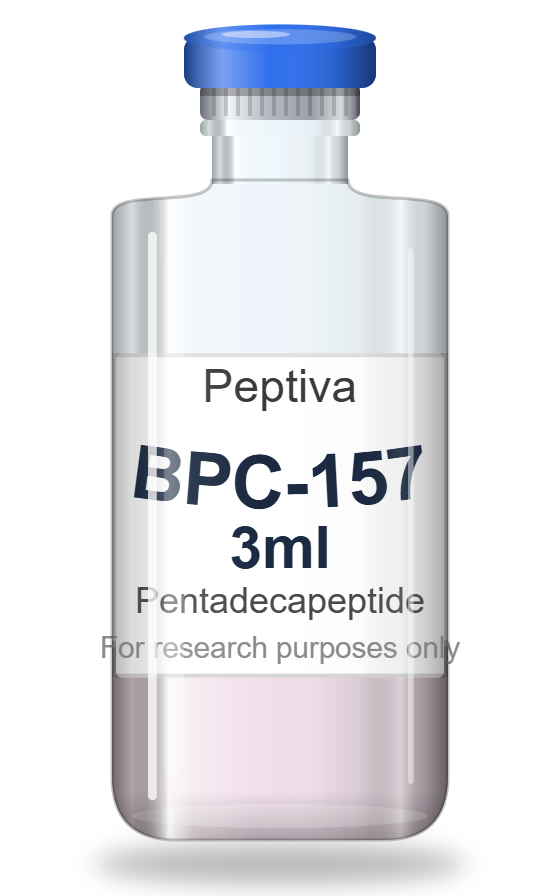
BPC-157
Lyophilised powder · 3 ml glass vial.
- Pentadecapeptide BPC-157
- C₆₂H₉₈N₁₆O₂₂
- CAS: 137525-51-0
BPC-157 (Body Protection Compound 157) is a synthetic pentadecapeptide: a chain of 15 amino acids (Gly-Glu-Pro-Pro-Pro-Gly-Lys-Pro-Ala-Asp-Asp-Ala-Gly-Leu-Val) derived from a protective protein found in gastric juice. Molecular formula C₆₂H₉₈N₁₆O₂₂, molecular weight approximately 1419 g/mol. CAS 137525-51-0.
It is one of the most frequently studied peptides in preclinical research. Published studies, predominantly in rodent models and cell culture, have examined its effects on tendon and ligament fibroblasts, the healing of soft tissue and gastrointestinal lesions, angiogenesis and the nitric-oxide system. It is not an approved medicine in any jurisdiction and no human clinical use is established.
Supplied as a lyophilised (freeze-dried) powder in a sealed 3 ml glass vial, with a batch certificate of analysis showing HPLC purity and mass-spectrometry identity.
Handling and storage: keep the sealed vial refrigerated (2–8 °C), or frozen at −20 °C for long-term storage, protected from light. Reconstituted solutions should be kept refrigerated and used within the period stated on the certificate of analysis. Avoid repeated freeze–thaw cycles.
For laboratory research use only. Not for human or veterinary administration.
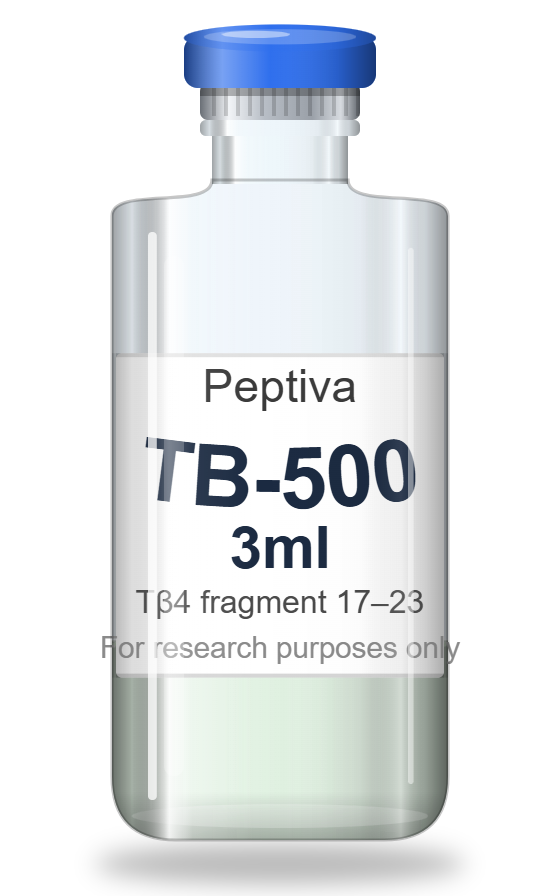
TB-500
Lyophilised powder · 3 ml glass vial.
- N-Acetyl Thymosin Beta-4 Fragment (17–23)
- C₃₈H₆₈N₁₀O₁₄
- CAS: 885340-08-9
TB-500 is a synthetic peptide corresponding to the active fragment (residues 17–23, Ac-LKKTETQ) of thymosin beta-4, a naturally occurring 43-amino-acid protein present in most human and animal cells, where it acts as a major actin-sequestering molecule. Molecular formula of the fragment C₃₈H₆₈N₁₀O₁₄, molecular weight approximately 889 g/mol. CAS 885340-08-9.
Thymosin beta-4 and its fragments have been studied in preclinical models for their role in cell migration, actin regulation, angiogenesis and tissue repair, including work on cardiac, corneal and dermal tissue. These findings come from in-vitro and animal studies; the peptide is not an approved medicine and no human clinical use is established.
Supplied as a lyophilised (freeze-dried) powder in a sealed 3 ml glass vial, with a batch certificate of analysis showing HPLC purity and mass-spectrometry identity.
Handling and storage: keep the sealed vial refrigerated (2–8 °C), or frozen at −20 °C for long-term storage, protected from light. Reconstituted solutions should be kept refrigerated and used within the period stated on the certificate of analysis. Avoid repeated freeze–thaw cycles.
For laboratory research use only. Not for human or veterinary administration.
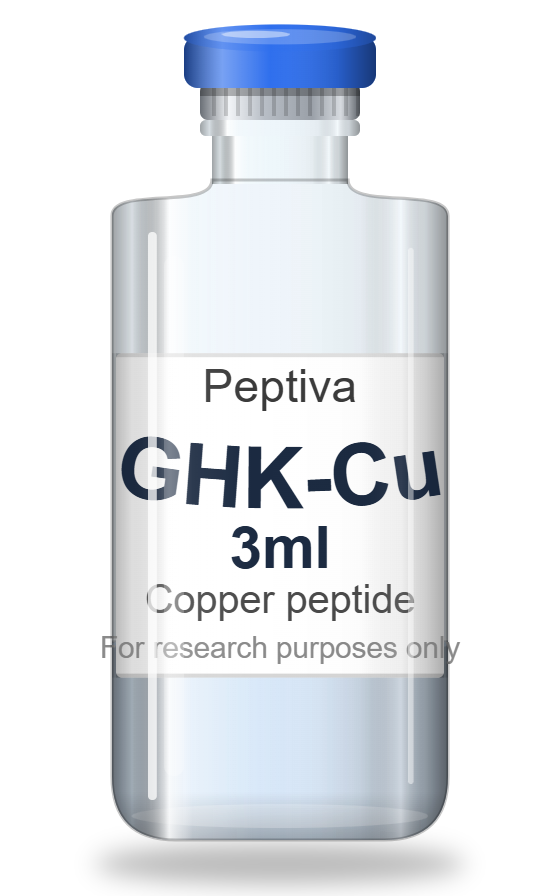
GHK-Cu
Lyophilised powder · 3 ml glass vial.
- Copper(II) Glycyl-L-Histidyl-L-Lysine Complex
- Formula varies by complex form
- CAS: 89030-95-5
GHK-Cu is the tripeptide glycyl-L-histidyl-L-lysine (GHK, C₁₄H₂₄N₆O₄, molecular weight 340.4 g/mol) complexed with a copper(II) ion. GHK occurs naturally in human plasma, saliva and urine, and its plasma concentration is reported to decline with age. The exact formula of the supplied material depends on the complex form and hydration; CAS 89030-95-5 refers to the copper complex. It is a characteristic blue powder.
GHK-Cu has been studied in cell culture and animal models in relation to wound repair, collagen and glycosaminoglycan synthesis by fibroblasts, antioxidant and anti-inflammatory gene expression, and hair-follicle biology. It is widely used as a research material and as an ingredient in cosmetic formulations. It is not an approved medicine.
Handling and storage: store the sealed vial cool and dry, protected from light. GHK-Cu is comparatively stable; solutions should be made fresh and kept refrigerated.
Supplied as a lyophilised (freeze-dried) powder in a sealed 3 ml glass vial, with a batch certificate of analysis showing HPLC purity and mass-spectrometry identity.
Handling and storage: keep the sealed vial refrigerated (2–8 °C), or frozen at −20 °C for long-term storage, protected from light. Reconstituted solutions should be kept refrigerated and used within the period stated on the certificate of analysis. Avoid repeated freeze–thaw cycles.
For laboratory research use only. Not for human or veterinary administration.
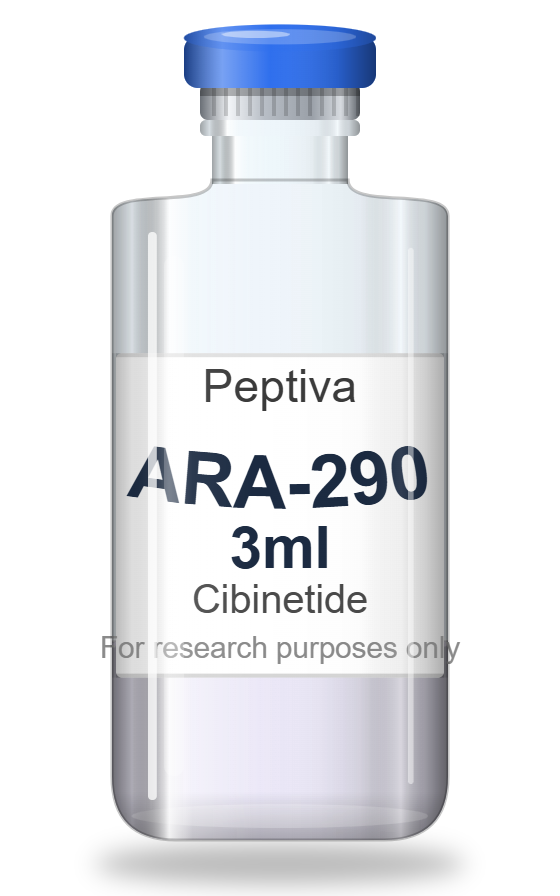
ARA-290
Lyophilised powder · 3 ml glass vial.
- Cibinetide (Pyroglutamate Helix-B Surface Peptide)
- C₅₁H₈₄N₁₆O₂₁
- CAS: 1208243-50-8
ARA-290 (cibinetide) is a synthetic 11-amino-acid linear peptide derived from the helix-B region of erythropoietin. It was engineered to engage the innate repair receptor (the heteromer of the erythropoietin receptor and the β-common receptor) while having no erythropoietic activity, so it does not stimulate red-cell production. Molecular formula C₅₁H₈₄N₁₆O₂₁, molecular weight approximately 1257 g/mol. CAS 1208243-50-8.
It has been investigated in preclinical models of tissue protection and inflammation and in clinical trials, most notably for small-fibre neuropathy in sarcoidosis and in type 2 diabetes. It is not an approved medicine in any jurisdiction.
Supplied as a lyophilised (freeze-dried) powder in a sealed 3 ml glass vial, with a batch certificate of analysis showing HPLC purity and mass-spectrometry identity.
Handling and storage: keep the sealed vial refrigerated (2–8 °C), or frozen at −20 °C for long-term storage, protected from light. Reconstituted solutions should be kept refrigerated and used within the period stated on the certificate of analysis. Avoid repeated freeze–thaw cycles.
For laboratory research use only. Not for human or veterinary administration.
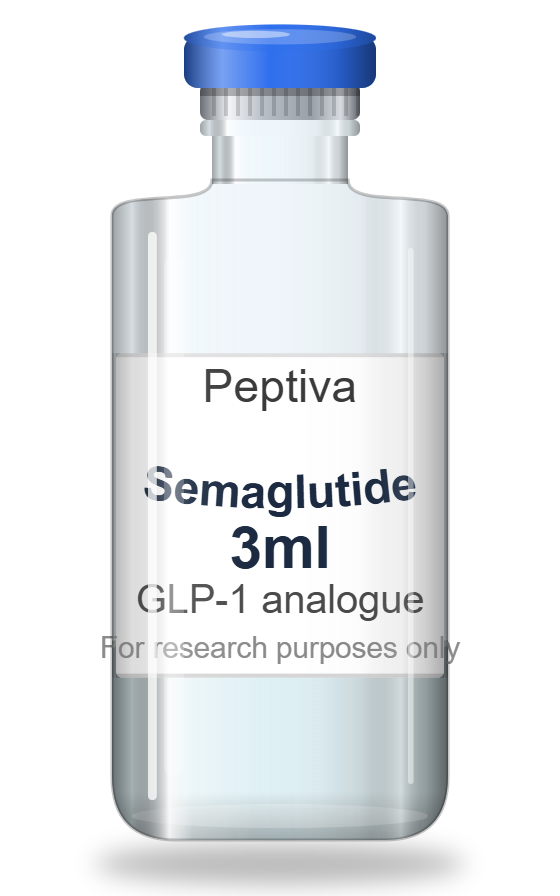
Semaglutide
Lyophilised powder · 3 ml glass vial.
- GLP-1 Analogue Peptide
- C₁₈₇H₂₉₁N₄₅O₅₉
- CAS: 910463-68-2
Semaglutide is a synthetic analogue of human glucagon-like peptide-1 (GLP-1 7–37) in which two amino acids are substituted (α-aminoisobutyric acid at position 8 and arginine at position 34) and a C-18 fatty diacid is attached through a linker at lysine 26. The fatty-acid side chain binds albumin, which gives the molecule its long half-life. Molecular formula C₁₈₇H₂₉₁N₄₅O₅₉, molecular weight approximately 4114 g/mol. CAS 910463-68-2.
Semaglutide is the active ingredient of licensed medicines sold under other brand names. The material supplied here is a research-grade reference peptide for laboratory work on GLP-1 receptor pharmacology, insulin secretion, gastric emptying and appetite regulation in cell and animal models. It is not supplied as, and must not be used as, a medicine.
Supplied as a lyophilised (freeze-dried) powder in a sealed 3 ml glass vial, with a batch certificate of analysis showing HPLC purity and mass-spectrometry identity.
Handling and storage: keep the sealed vial refrigerated (2–8 °C), or frozen at −20 °C for long-term storage, protected from light. Reconstituted solutions should be kept refrigerated and used within the period stated on the certificate of analysis. Avoid repeated freeze–thaw cycles.
For laboratory research use only. Not for human or veterinary administration.
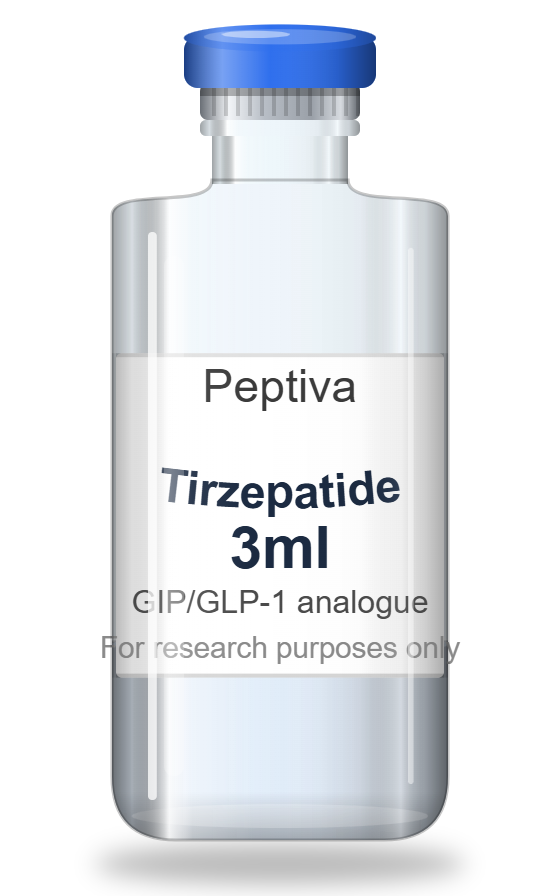
Tirzepatide
Lyophilised powder · 3 ml glass vial.
- GIP/GLP-1 Analogue Peptide
- C₂₂₅H₃₄₈N₄₈O₆₈
- CAS: 2023788-19-2
Tirzepatide is a synthetic 39-amino-acid peptide based on the sequence of glucose-dependent insulinotropic polypeptide (GIP), engineered to act as an agonist at both the GIP receptor and the GLP-1 receptor. A C-20 fatty diacid moiety attached via a linker at lysine 20 gives it a long half-life through albumin binding. Molecular formula C₂₂₅H₃₄₈N₄₈O₆₈, molecular weight approximately 4813 g/mol. CAS 2023788-19-2.
Tirzepatide is the active ingredient of licensed medicines sold under other brand names. The material supplied here is a research-grade reference peptide for laboratory studies of dual incretin-receptor pharmacology, glucose homeostasis and energy balance in cell and animal models. It is not supplied as, and must not be used as, a medicine.
Supplied as a lyophilised (freeze-dried) powder in a sealed 3 ml glass vial, with a batch certificate of analysis showing HPLC purity and mass-spectrometry identity.
Handling and storage: keep the sealed vial refrigerated (2–8 °C), or frozen at −20 °C for long-term storage, protected from light. Reconstituted solutions should be kept refrigerated and used within the period stated on the certificate of analysis. Avoid repeated freeze–thaw cycles.
For laboratory research use only. Not for human or veterinary administration.
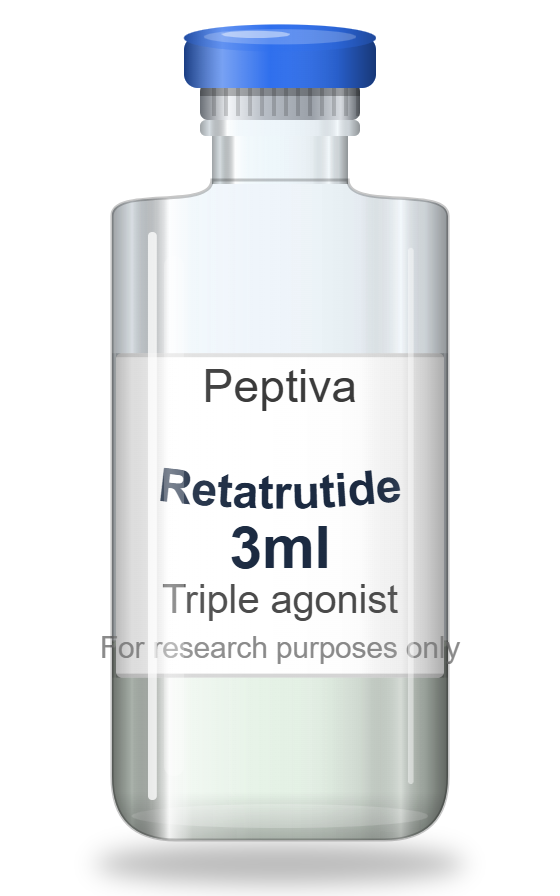
Retatrutide
Lyophilised powder · 3 ml glass vial.
- GIP/GLP-1/Glucagon Analogue Peptide
- C₂₂₁H₃₄₂N₄₆O₆₈
- CAS: 2381089-83-2
Retatrutide is an investigational synthetic 39-amino-acid peptide designed as a triple agonist of the GIP, GLP-1 and glucagon receptors. Like related incretin analogues it carries a C-20 fatty diacid side chain for albumin binding and an extended half-life. Molecular formula C₂₂₁H₃₄₂N₄₆O₆₈, molecular weight approximately 4731 g/mol. CAS 2381089-83-2.
At the time of writing retatrutide is in late-stage clinical trials for obesity and related metabolic conditions and is not an approved medicine anywhere. The material supplied here is a research-grade reference peptide for laboratory studies of multi-receptor incretin pharmacology and energy metabolism in cell and animal models.
Supplied as a lyophilised (freeze-dried) powder in a sealed 3 ml glass vial, with a batch certificate of analysis showing HPLC purity and mass-spectrometry identity.
Handling and storage: keep the sealed vial refrigerated (2–8 °C), or frozen at −20 °C for long-term storage, protected from light. Reconstituted solutions should be kept refrigerated and used within the period stated on the certificate of analysis. Avoid repeated freeze–thaw cycles.
For laboratory research use only. Not for human or veterinary administration.
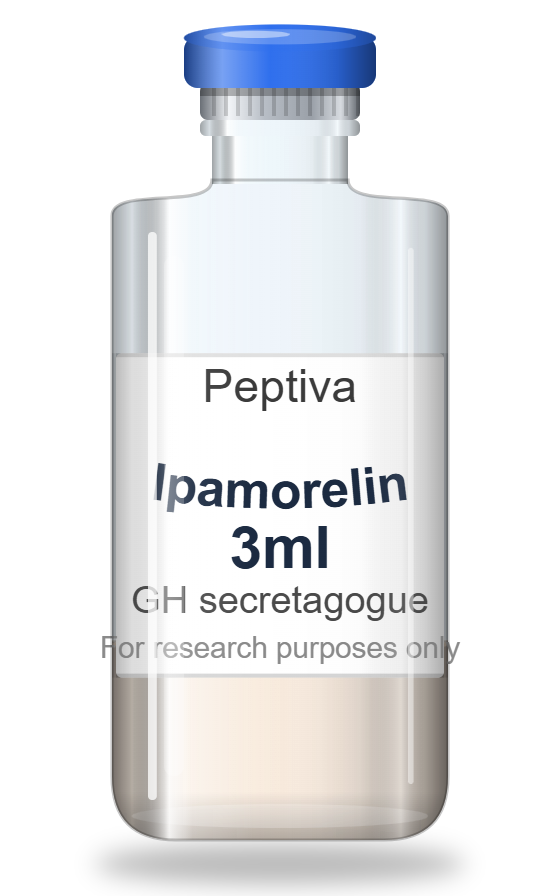
Ipamorelin
Lyophilised powder · 3 ml glass vial.
- Synthetic Pentapeptide Growth Hormone Secretagogue
- C₃₈H₄₉N₉O₅
- CAS: 170851-70-4
Ipamorelin is a synthetic pentapeptide (Aib-His-D-2-Nal-D-Phe-Lys-NH₂) and a selective agonist of the ghrelin receptor (growth hormone secretagogue receptor, GHS-R1a). Molecular formula C₃₈H₄₉N₉O₅, molecular weight approximately 711.9 g/mol. CAS 170851-70-4.
In animal studies it stimulated growth-hormone release with little effect on ACTH, cortisol or prolactin, which is why it is used as a selective tool compound in research on growth-hormone secretion and gastrointestinal motility. It is not an approved medicine.
Supplied as a lyophilised (freeze-dried) powder in a sealed 3 ml glass vial, with a batch certificate of analysis showing HPLC purity and mass-spectrometry identity.
Handling and storage: keep the sealed vial refrigerated (2–8 °C), or frozen at −20 °C for long-term storage, protected from light. Reconstituted solutions should be kept refrigerated and used within the period stated on the certificate of analysis. Avoid repeated freeze–thaw cycles.
For laboratory research use only. Not for human or veterinary administration.
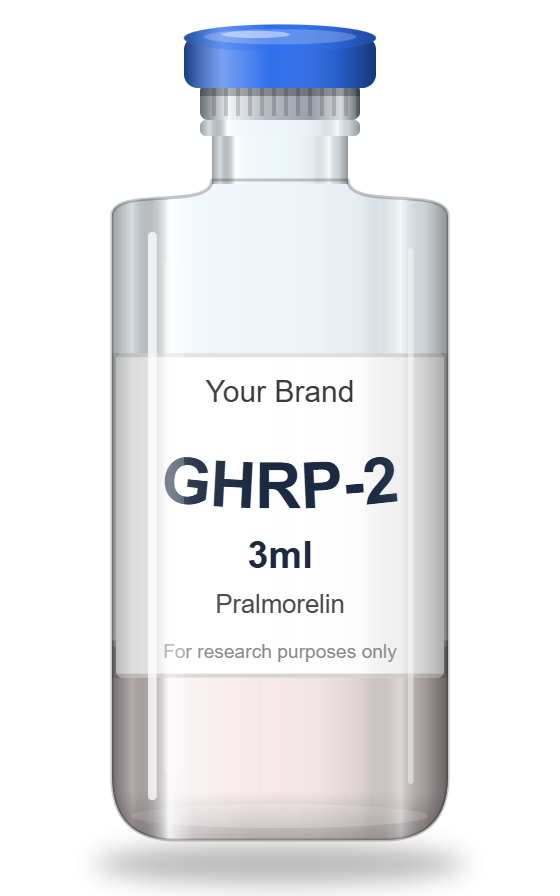
GHRP-2
Lyophilised powder · 3 ml glass vial.
- Pralmorelin (Growth Hormone-Releasing Hexapeptide)
- C₄₅H₅₅N₉O₆
- CAS: 158861-67-7
GHRP-2 (pralmorelin) is a synthetic hexapeptide (D-Ala-D-2-Nal-Ala-Trp-D-Phe-Lys-NH₂) and a potent agonist of the ghrelin receptor. Molecular formula C₄₅H₅₅N₉O₆, molecular weight approximately 818 g/mol. CAS 158861-67-7.
Pralmorelin has been used in Japan as a diagnostic agent for growth-hormone deficiency. The material supplied here is a research-grade reference peptide used in studies of growth-hormone secretion, ghrelin-receptor signalling and appetite regulation in cell and animal models. It is not supplied as a medicine.
Supplied as a lyophilised (freeze-dried) powder in a sealed 3 ml glass vial, with a batch certificate of analysis showing HPLC purity and mass-spectrometry identity.
Handling and storage: keep the sealed vial refrigerated (2–8 °C), or frozen at −20 °C for long-term storage, protected from light. Reconstituted solutions should be kept refrigerated and used within the period stated on the certificate of analysis. Avoid repeated freeze–thaw cycles.
For laboratory research use only. Not for human or veterinary administration.
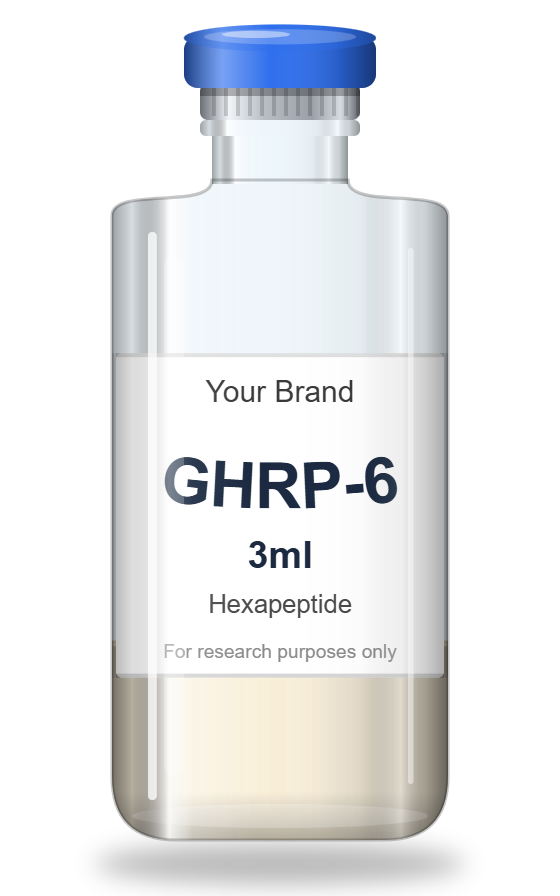
GHRP-6
Lyophilised powder · 3 ml glass vial.
- Growth Hormone-Releasing Hexapeptide-6
- C₄₆H₅₆N₁₂O₆
- CAS: 87616-84-0
GHRP-6 is a synthetic hexapeptide (His-D-Trp-Ala-Trp-D-Phe-Lys-NH₂), the first of the growth-hormone-releasing peptides, and an agonist of the ghrelin receptor. Molecular formula C₄₆H₅₆N₁₂O₆, molecular weight approximately 873 g/mol. CAS 87616-84-0.
It is used in research on growth-hormone secretion, feeding behaviour and, in preclinical models, cardioprotection and tissue repair. Unlike ipamorelin it also raises ACTH, cortisol and prolactin in animal studies, which makes the pair useful for comparative work. It is not an approved medicine.
Supplied as a lyophilised (freeze-dried) powder in a sealed 3 ml glass vial, with a batch certificate of analysis showing HPLC purity and mass-spectrometry identity.
Handling and storage: keep the sealed vial refrigerated (2–8 °C), or frozen at −20 °C for long-term storage, protected from light. Reconstituted solutions should be kept refrigerated and used within the period stated on the certificate of analysis. Avoid repeated freeze–thaw cycles.
For laboratory research use only. Not for human or veterinary administration.
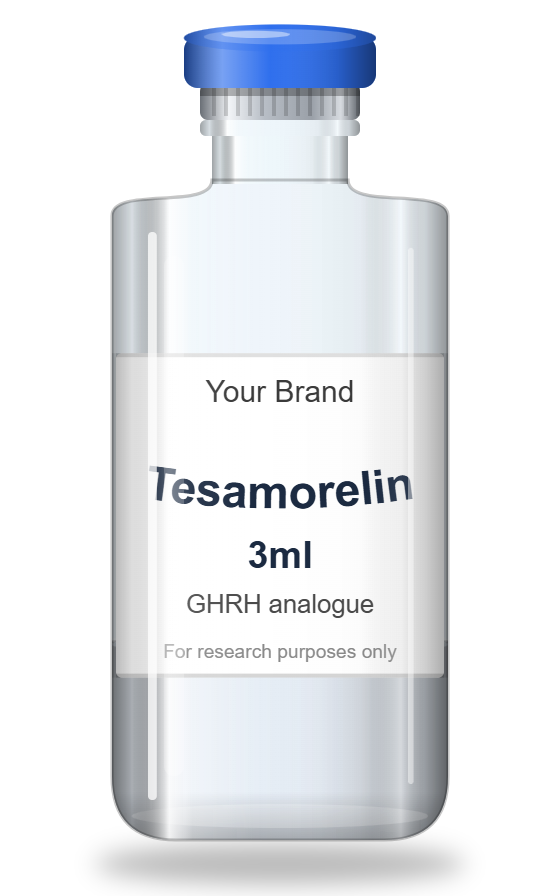
Tesamorelin
Lyophilised powder · 3 ml glass vial.
- Stabilised Growth Hormone-Releasing Hormone Analogue
- C₂₂₁H₃₆₆N₇₂O₆₇S
- CAS: 218949-48-5
Tesamorelin is a synthetic analogue of the 44-amino-acid human growth-hormone-releasing hormone (GHRH 1–44) with a trans-3-hexenoic acid group on the N-terminus, which protects it from rapid enzymatic breakdown. Molecular formula C₂₂₁H₃₆₆N₇₂O₆₇S, molecular weight approximately 5136 g/mol. CAS 218949-48-5.
Tesamorelin is the active ingredient of a licensed medicine sold under another brand name. The material supplied here is a research-grade reference peptide for laboratory work on GHRH-receptor pharmacology and the growth-hormone / IGF-1 axis. It is not supplied as, and must not be used as, a medicine.
Supplied as a lyophilised (freeze-dried) powder in a sealed 3 ml glass vial, with a batch certificate of analysis showing HPLC purity and mass-spectrometry identity.
Handling and storage: keep the sealed vial refrigerated (2–8 °C), or frozen at −20 °C for long-term storage, protected from light. Reconstituted solutions should be kept refrigerated and used within the period stated on the certificate of analysis. Avoid repeated freeze–thaw cycles.
For laboratory research use only. Not for human or veterinary administration.
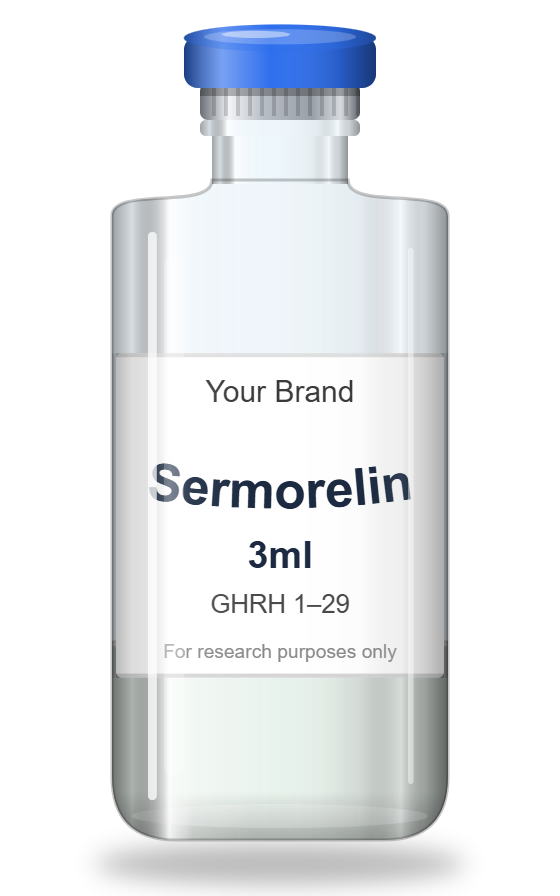
Sermorelin
Lyophilised powder · 3 ml glass vial.
- Growth Hormone-Releasing Hormone Fragment (1–29) Amide
- C₁₄₉H₂₄₆N₄₄O₄₂S
- CAS: 86168-78-7
Sermorelin is the amidated 1–29 fragment of human growth-hormone-releasing hormone, the shortest fragment that retains full activity at the GHRH receptor. Molecular formula C₁₄₉H₂₄₆N₄₄O₄₂S, molecular weight approximately 3358 g/mol. CAS 86168-78-7.
It was formerly licensed as a diagnostic agent for growth-hormone deficiency (since withdrawn from the market for commercial reasons). The material supplied here is a research-grade reference peptide for studies of hypothalamic–pituitary signalling and growth-hormone release. It is not supplied as a medicine.
Supplied as a lyophilised (freeze-dried) powder in a sealed 3 ml glass vial, with a batch certificate of analysis showing HPLC purity and mass-spectrometry identity.
Handling and storage: keep the sealed vial refrigerated (2–8 °C), or frozen at −20 °C for long-term storage, protected from light. Reconstituted solutions should be kept refrigerated and used within the period stated on the certificate of analysis. Avoid repeated freeze–thaw cycles.
For laboratory research use only. Not for human or veterinary administration.
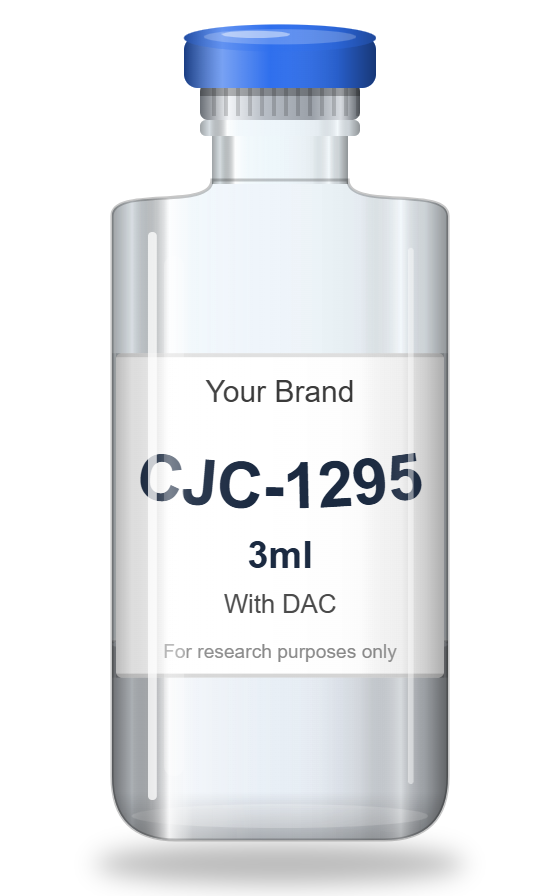
CJC-1295 (With DAC)
Lyophilised powder · 3 ml glass vial.
- Drug Affinity Complex Growth Hormone-Releasing Hormone Analogue
- C₁₆₅H₂₆₉N₄₇O₄₆
- CAS: 446262-90-4
CJC-1295 with DAC is a synthetic 30-amino-acid analogue of growth-hormone-releasing hormone (GHRH 1–29) carrying four amino-acid substitutions (D-Ala², Gln⁸, Ala¹⁵, Leu²⁷) that protect it from enzymatic breakdown, together with a Drug Affinity Complex: a lysine-linked maleimidopropionic acid group that forms a covalent bond with serum albumin. That albumin binding is what gives the DAC form its long half-life, reported at around six to eight days in published pharmacokinetic studies. Molecular formula C₁₆₅H₂₆₉N₄₇O₄₆, molecular weight approximately 3648 g/mol. CAS 446262-90-4.
It was developed by ConjuChem and taken into clinical trials, but development was discontinued and it is not an approved medicine anywhere. The material supplied here is a research-grade reference peptide for laboratory studies of sustained GHRH-receptor stimulation and the growth-hormone / IGF-1 axis in cell and animal models.
Supplied as a lyophilised (freeze-dried) powder in a sealed 3 ml glass vial, with a batch certificate of analysis showing HPLC purity and mass-spectrometry identity.
Handling and storage: keep the sealed vial refrigerated (2–8 °C), or frozen at −20 °C for long-term storage, protected from light. Reconstituted solutions should be kept refrigerated and used within the period stated on the certificate of analysis. Avoid repeated freeze–thaw cycles.
For laboratory research use only. Not for human or veterinary administration.
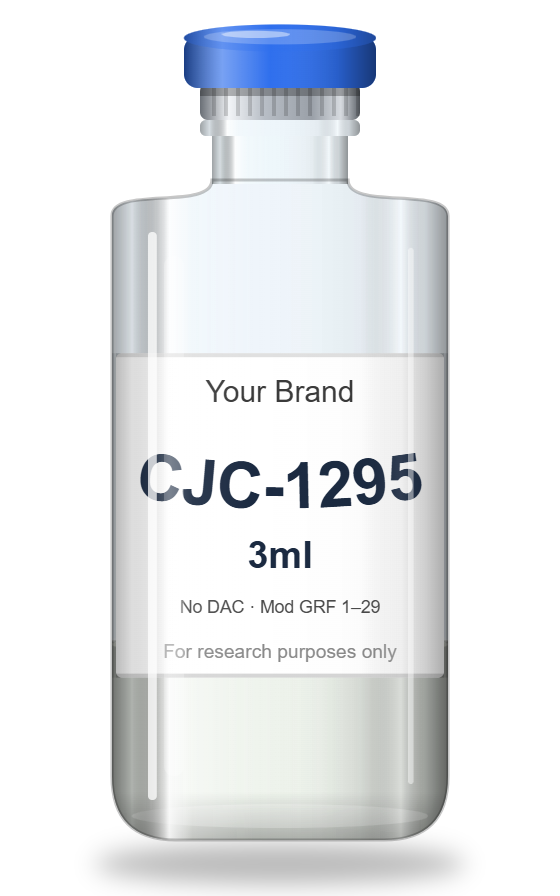
CJC-1295 (Without DAC)
Lyophilised powder · 3 ml glass vial.
- CJC-1295 No DAC, Modified Growth Hormone-Releasing Factor (1–29)
- C₁₅₂H₂₅₂N₄₄O₄₂
- CAS: 863288-34-0
CJC-1295 without DAC, also called modified GRF (1–29), is the same tetra-substituted 29-amino-acid GHRH analogue (D-Ala², Gln⁸, Ala¹⁵, Leu²⁷) as the DAC form but without the albumin-binding group. Without that group it is cleared quickly, with a half-life measured in minutes rather than days. Molecular formula C₁₅₂H₂₅₂N₄₄O₄₂, molecular weight approximately 3368 g/mol. CAS 863288-34-0.
Because the two forms share a sequence and differ only in duration, they are used together in research comparing pulsatile and sustained GHRH-receptor stimulation in animal models. It is not an approved medicine; the material supplied here is a research-grade reference peptide for laboratory use.
Supplied as a lyophilised (freeze-dried) powder in a sealed 3 ml glass vial, with a batch certificate of analysis showing HPLC purity and mass-spectrometry identity.
Handling and storage: keep the sealed vial refrigerated (2–8 °C), or frozen at −20 °C for long-term storage, protected from light. Reconstituted solutions should be kept refrigerated and used within the period stated on the certificate of analysis. Avoid repeated freeze–thaw cycles.
For laboratory research use only. Not for human or veterinary administration.
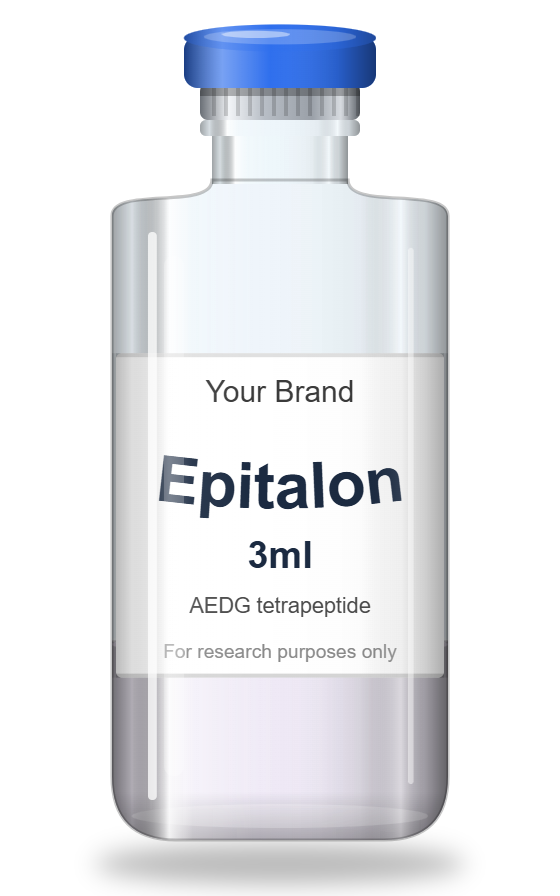
Epitalon
Lyophilised powder · 3 ml glass vial.
- Ala-Glu-Asp-Gly Tetrapeptide (AEDG)
- C₁₄H₂₂N₄O₉
- CAS: 64082-79-7
Epitalon (epithalon) is the synthetic tetrapeptide Ala-Glu-Asp-Gly, designed from the composition of the bovine pineal extract epithalamin. Molecular formula C₁₄H₂₂N₄O₉, molecular weight approximately 390.4 g/mol. CAS 64082-79-7.
Most of the published work comes from Russian research groups and covers telomerase activity in cultured human cells, pineal and circadian function, and lifespan studies in rodents. These findings have not been confirmed in large independent trials and the peptide is not an approved medicine.
Supplied as a lyophilised (freeze-dried) powder in a sealed 3 ml glass vial, with a batch certificate of analysis showing HPLC purity and mass-spectrometry identity.
Handling and storage: keep the sealed vial refrigerated (2–8 °C), or frozen at −20 °C for long-term storage, protected from light. Reconstituted solutions should be kept refrigerated and used within the period stated on the certificate of analysis. Avoid repeated freeze–thaw cycles.
For laboratory research use only. Not for human or veterinary administration.
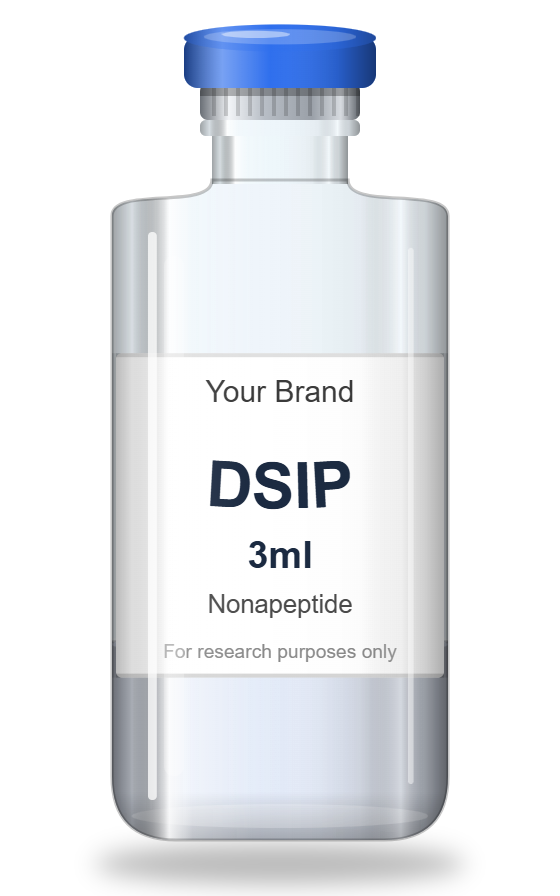
DSIP
Lyophilised powder · 3 ml glass vial.
- Delta Sleep-Inducing Nonapeptide
- C₃₅H₄₈N₁₀O₁₅
- CAS: 62568-57-4
Delta sleep-inducing peptide (DSIP) is the nonapeptide Trp-Ala-Gly-Gly-Asp-Ala-Ser-Gly-Glu, first isolated in 1977 from the cerebral venous blood of rabbits during induced slow-wave sleep. Molecular formula C₃₅H₄₈N₁₀O₁₅, molecular weight approximately 848.8 g/mol. CAS 62568-57-4.
It has been studied in animal models for effects on sleep architecture, stress responses, pain thresholds and endocrine secretion. Results across studies are mixed and its physiological role remains unclear. It is not an approved medicine.
Supplied as a lyophilised (freeze-dried) powder in a sealed 3 ml glass vial, with a batch certificate of analysis showing HPLC purity and mass-spectrometry identity.
Handling and storage: keep the sealed vial refrigerated (2–8 °C), or frozen at −20 °C for long-term storage, protected from light. Reconstituted solutions should be kept refrigerated and used within the period stated on the certificate of analysis. Avoid repeated freeze–thaw cycles.
For laboratory research use only. Not for human or veterinary administration.
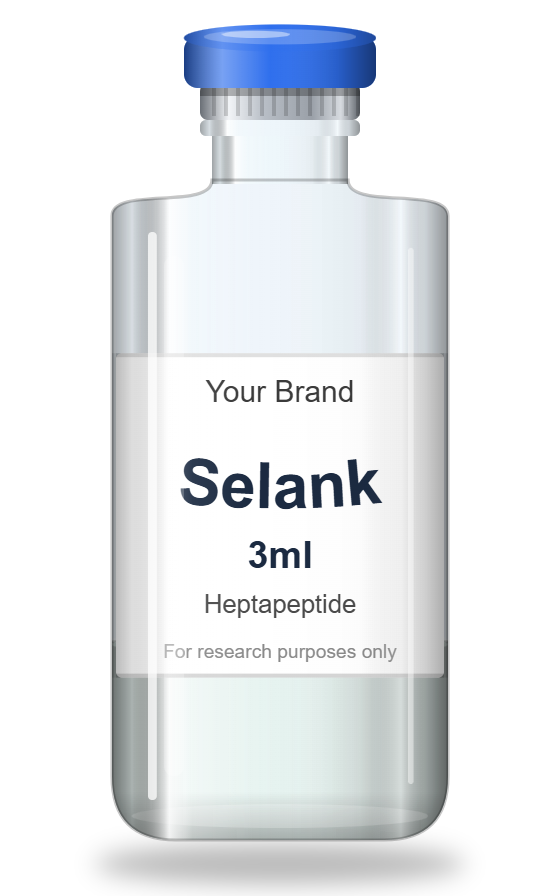
Selank
Lyophilised powder · 3 ml glass vial.
- Thr-Lys-Pro-Arg-Pro-Gly-Pro Heptapeptide
- C₃₃H₅₇N₁₁O₉
- CAS: 129954-34-3
Selank is the synthetic heptapeptide Thr-Lys-Pro-Arg-Pro-Gly-Pro, an analogue of the immunomodulatory tetrapeptide tuftsin extended with Pro-Gly-Pro to improve stability. It was developed at the Institute of Molecular Genetics of the Russian Academy of Sciences. Molecular formula C₃₃H₅₇N₁₁O₉, molecular weight approximately 751.9 g/mol. CAS 129954-34-3.
Published research, largely from Russia, examines anxiolytic and nootropic effects in rodent models, together with changes in gene expression linked to inflammation and neurotransmission. It is registered in Russia as a nasal product but is not an approved medicine elsewhere; the material supplied here is for laboratory research only.
Supplied as a lyophilised (freeze-dried) powder in a sealed 3 ml glass vial, with a batch certificate of analysis showing HPLC purity and mass-spectrometry identity.
Handling and storage: keep the sealed vial refrigerated (2–8 °C), or frozen at −20 °C for long-term storage, protected from light. Reconstituted solutions should be kept refrigerated and used within the period stated on the certificate of analysis. Avoid repeated freeze–thaw cycles.
For laboratory research use only. Not for human or veterinary administration.
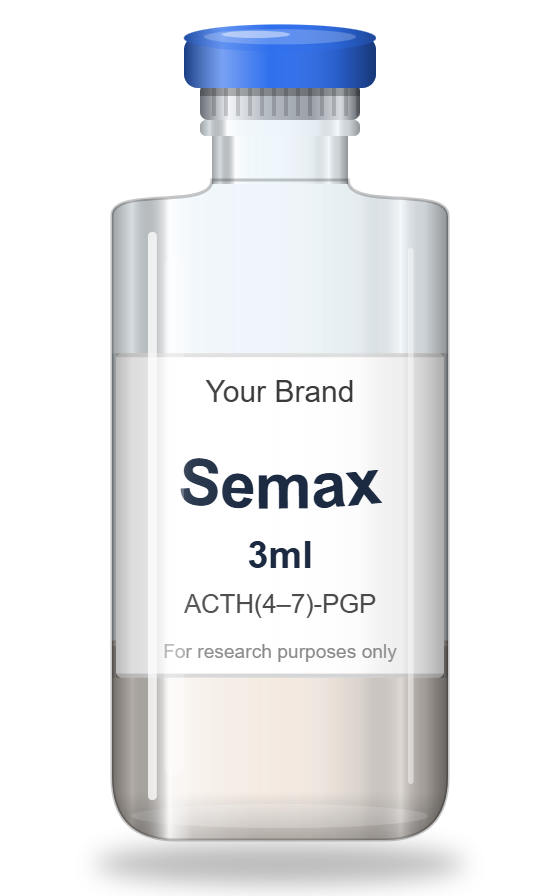
Semax
Lyophilised powder · 3 ml glass vial.
- ACTH(4–7)-Pro-Gly-Pro Heptapeptide
- C₃₇H₅₁N₉O₁₀S
- CAS: 80714-61-0
Semax is the synthetic heptapeptide Met-Glu-His-Phe-Pro-Gly-Pro: the 4–7 fragment of adrenocorticotropic hormone (ACTH) extended with Pro-Gly-Pro, which removes hormonal activity and improves stability. Molecular formula C₃₇H₅₁N₉O₁₀S, molecular weight approximately 813.9 g/mol. CAS 80714-61-0.
Research, mostly from Russian groups, reports effects on BDNF and other neurotrophin expression, attention and memory tasks in rodents, and neuroprotection in ischaemia models. It is registered in Russia as a nasal product but is not an approved medicine elsewhere; the material supplied here is for laboratory research only.
Supplied as a lyophilised (freeze-dried) powder in a sealed 3 ml glass vial, with a batch certificate of analysis showing HPLC purity and mass-spectrometry identity.
Handling and storage: keep the sealed vial refrigerated (2–8 °C), or frozen at −20 °C for long-term storage, protected from light. Reconstituted solutions should be kept refrigerated and used within the period stated on the certificate of analysis. Avoid repeated freeze–thaw cycles.
For laboratory research use only. Not for human or veterinary administration.
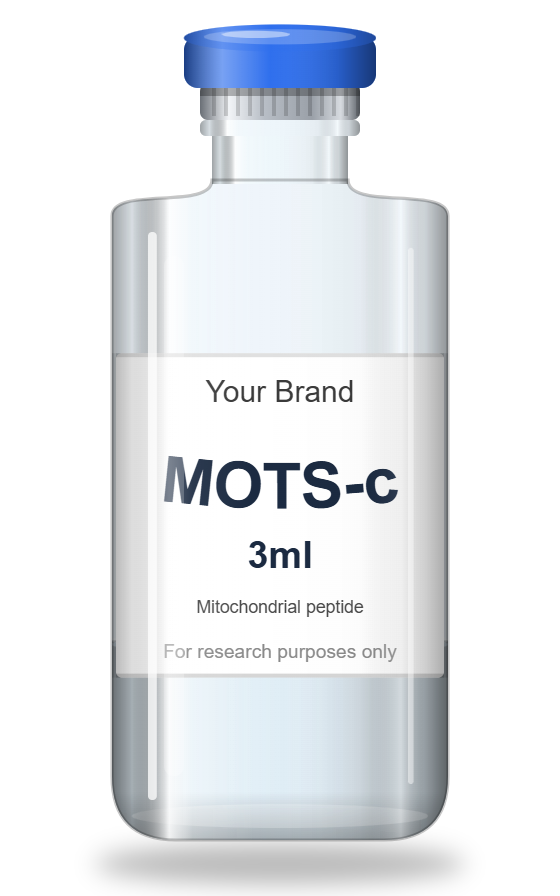
MOTS-c
Lyophilised powder · 3 ml glass vial.
- Mitochondrial-Derived 16-Amino-Acid Peptide
- C₁₀₁H₁₅₂N₂₈O₂₂S₂
- CAS: 1627580-64-6
MOTS-c (mitochondrial open reading frame of the 12S rRNA type-c) is a 16-amino-acid peptide encoded within the mitochondrial genome and described in 2015. Molecular formula C₁₀₁H₁₅₂N₂₈O₂₂S₂, molecular weight approximately 2175 g/mol. CAS 1627580-64-6.
It is studied as a mitochondrial signalling peptide: work in cell culture and mice links it to AMPK activation, glucose and fatty-acid metabolism, insulin sensitivity and the response to exercise, and its circulating levels have been measured in human cohorts. It is not an approved medicine.
Supplied as a lyophilised (freeze-dried) powder in a sealed 3 ml glass vial, with a batch certificate of analysis showing HPLC purity and mass-spectrometry identity.
Handling and storage: keep the sealed vial refrigerated (2–8 °C), or frozen at −20 °C for long-term storage, protected from light. Reconstituted solutions should be kept refrigerated and used within the period stated on the certificate of analysis. Avoid repeated freeze–thaw cycles.
For laboratory research use only. Not for human or veterinary administration.
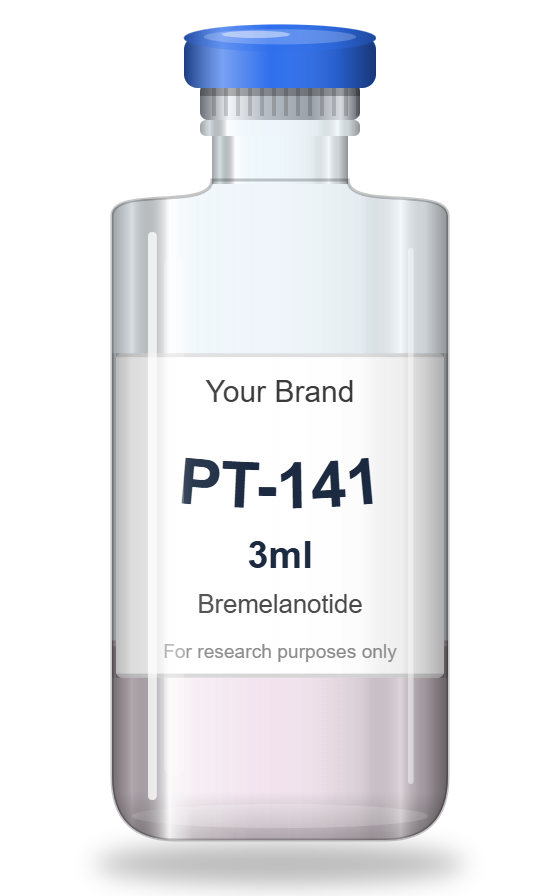
PT-141
Lyophilised powder · 3 ml glass vial.
- Bremelanotide (Cyclic Melanocortin Peptide)
- C₅₀H₆₈N₁₄O₁₀
- CAS: 189691-06-3
PT-141 (bremelanotide) is a synthetic cyclic heptapeptide and an agonist of melanocortin receptors, with highest activity at the MC4 receptor. It is a metabolite-derived analogue of Melanotan II lacking the C-terminal amide. Molecular formula C₅₀H₆₈N₁₄O₁₀, molecular weight approximately 1025 g/mol. CAS 189691-06-3.
Bremelanotide is the active ingredient of a licensed medicine sold under another brand name. The material supplied here is a research-grade reference peptide for laboratory studies of melanocortin-receptor pharmacology in cell and animal models. It is not supplied as, and must not be used as, a medicine.
Supplied as a lyophilised (freeze-dried) powder in a sealed 3 ml glass vial, with a batch certificate of analysis showing HPLC purity and mass-spectrometry identity.
Handling and storage: keep the sealed vial refrigerated (2–8 °C), or frozen at −20 °C for long-term storage, protected from light. Reconstituted solutions should be kept refrigerated and used within the period stated on the certificate of analysis. Avoid repeated freeze–thaw cycles.
For laboratory research use only. Not for human or veterinary administration.
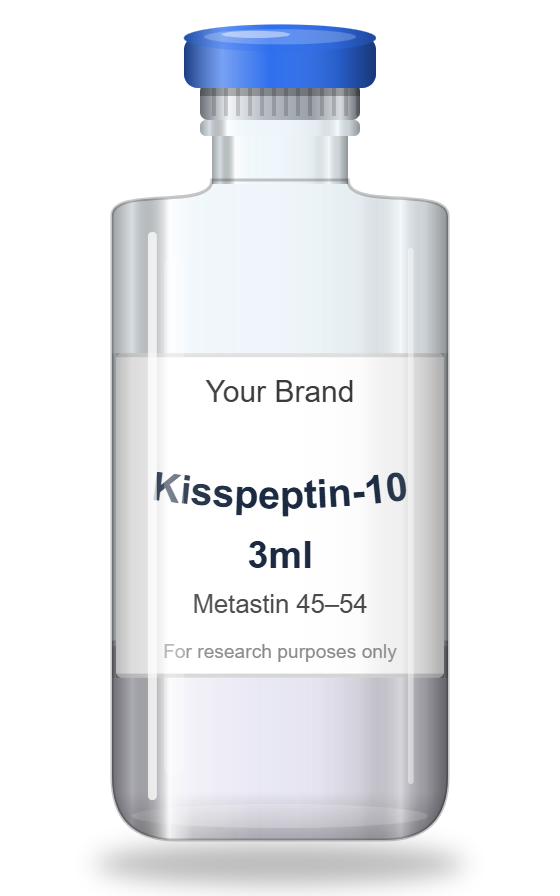
Kisspeptin-10
Lyophilised powder · 3 ml glass vial.
- Human Metastin Fragment (45–54)
- C₆₃H₈₃N₁₇O₁₄
- CAS: 374675-21-5
Kisspeptin-10 is the C-terminal decapeptide (residues 45–54) of human metastin, the product of the KISS1 gene, and is the shortest fragment with full activity at the kisspeptin receptor (KISS1R, formerly GPR54). Molecular formula C₆₃H₈₃N₁₇O₁₄, molecular weight approximately 1302 g/mol. CAS 374675-21-5.
Kisspeptin signalling is a key upstream regulator of gonadotropin-releasing hormone (GnRH) release, and kisspeptin-10 is a standard tool compound in reproductive endocrinology and neuroendocrine research, both in animal models and in clinical investigation. It is not an approved medicine.
Supplied as a lyophilised (freeze-dried) powder in a sealed 3 ml glass vial, with a batch certificate of analysis showing HPLC purity and mass-spectrometry identity.
Handling and storage: keep the sealed vial refrigerated (2–8 °C), or frozen at −20 °C for long-term storage, protected from light. Reconstituted solutions should be kept refrigerated and used within the period stated on the certificate of analysis. Avoid repeated freeze–thaw cycles.
For laboratory research use only. Not for human or veterinary administration.
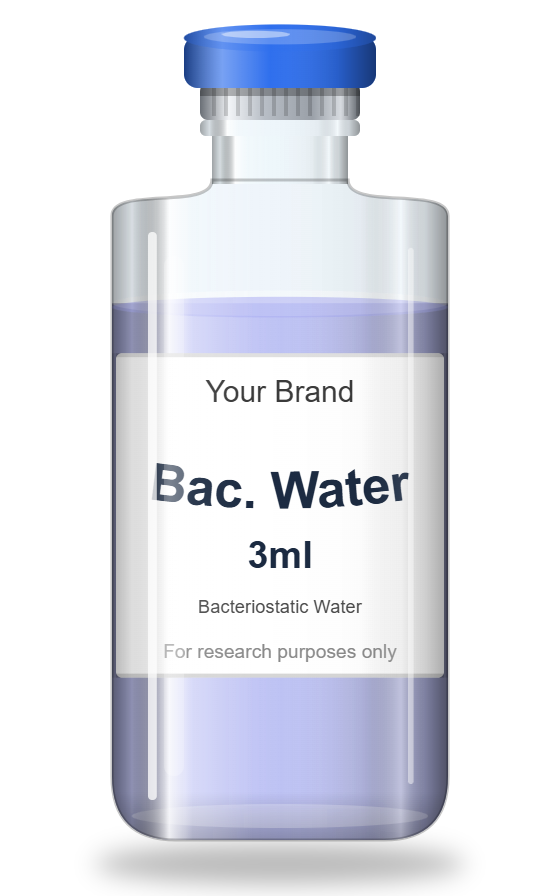
Bacteriostatic Water
3 ml glass vial.
- Bacteriostatic Water (0.9% Benzyl Alcohol)
- Water (H₂O) + Benzyl Alcohol (C₇H₈O)
- CAS: 7732-18-5 / 100-51-6
Bacteriostatic water is purified, sterile water containing 0.9% benzyl alcohol as a bacteriostatic preservative. The benzyl alcohol inhibits the growth of most bacteria, which is why this diluent is used in laboratories to reconstitute lyophilised peptides that will be drawn from a vial more than once over a period of days.
Supplied in a sealed 3 ml glass vial with a rubber stopper and aluminium crimp. Each vial is filled under clean conditions and carries a batch number for traceability.
Handling and storage: store at room temperature (15–25 °C) away from direct light. Once the stopper has been punctured, keep refrigerated and discard after 28 days or if the solution becomes cloudy. Not suitable for reconstituting materials that are incompatible with benzyl alcohol.
Composition: water (H₂O) with benzyl alcohol (C₇H₈O) 0.9% w/v. CAS 7732-18-5 / 100-51-6.
For laboratory research use only. Not for human or veterinary administration.
Laboratory Account Access
Product pricing and ordering are available exclusively to approved research organisations.
Important information
All products are CE certified and are sold under the premise and terms of that certification. They are supplied for commercial purposes only, to customers aged 18 or over.
Under no circumstances are these products to be used for aviation purposes.
Edit this notice once (left panel → Site Notice) and it updates on every page.